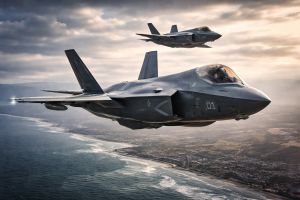
President Recep Tayyip Erdoğan has renewed calls for Türkiye’s reinstatement into the F-35 fighter jet programme, describing its removal as unjust and arguing that reentry would be vital for both NATO security and bilateral relations with the United States.
Türkiye was removed from the US-led multinational programme in 2019 after purchasing the Russian-made S-400 air defence system. Since then, Ankara has maintained that the decision was unfair and has sought a resolution, particularly following the return of Donald Trump to the White House.
Erdoğan said the issue was raised during his September meeting with Trump in Washington. Last week, Trump stated that the United States was “very seriously” considering the sale of F-35 jets to Türkiye.
“With Mr Trump’s return to office, an opportunity has emerged to place Türkiye–US relations on a more reasonable and constructive footing,” Erdoğan said on Monday.
Speaking to Bloomberg News, Erdoğan said the delivery of the F-35 aircraft Türkiye has already paid for, along with its reintegration into the programme, would strengthen both bilateral ties and NATO’s collective defence.
Fighter jet procurement and defence strategy
In late 2024, Türkiye finalised a $7 billion agreement with Washington to purchase 40 F-16 fighter jets. However, negotiations were reportedly complicated by Turkish concerns over pricing and Ankara’s continued preference for acquiring F-35 aircraft.
Erdoğan said Türkiye expects defence procurement terms to reflect alliance solidarity, pointing to recent European purchases as examples. In October, Ankara signed an agreement worth approximately £8 billion ($10.76 billion) with the United Kingdom to acquire 20 Eurofighter Typhoon jets. It also plans to purchase 12 second-hand Typhoons from Qatar and a further 12 from Oman.
Despite maintaining NATO’s second-largest army, Türkiye has historically faced arms embargoes, prompting a strategic shift over the past two decades towards domestic defence production. The country now manufactures a broad range of military systems, including drones, missiles and naval platforms.
Türkiye is also developing its own fifth-generation fighter jet, KAAN, which is intended to replace the air force’s ageing F-16 fleet from the 2030s onward.
Halkbank case and energy cooperation
Erdoğan also addressed the long-running US legal case involving Halkbank, saying Ankara considers the proceedings misguided and is seeking to prevent what it views as unjust penalties.
Halkbank was indicted in 2019 on charges of helping Iran evade US sanctions, allegations the lender has denied. Erdoğan said Türkiye hopes for a fair and lawful resolution to the case.
On energy cooperation, Erdoğan said Türkiye has significantly increased liquefied natural gas imports from the United States, which now plays a growing role in the country’s energy supply mix as part of efforts to reduce dependence on Russian energy.
In the second half of last year, state gas importer BOTAŞ signed several long-term LNG contracts, many involving US suppliers, benefiting from expanding global LNG capacity. The United States became Türkiye’s fourth-largest gas supplier in 2024, delivering approximately 5.5 billion cubic metres.
Turkish officials have also highlighted plans for US infrastructure investment and cooperation in nuclear energy, particularly in the development of small modular reactors.
“Türkiye’s position is very clear: we act in line with our national interests and energy security,” Erdoğan said. “As a country dependent on imports for a significant portion of its hydrocarbons, we must pursue a cautious and balanced approach in all matters affecting our energy security.”